Best Viewed on Computer
Bullet Points of Events from 1768 and on & Maps
Colonial Frustration Builds/British Response/Tensions Rise
-
The Townsend Acts placed tariffs on popular items fr/Britain to the 13 colonies. Competition was not allowed (1768). Many colonists were unhappy. The people of Boston especially let it be known.
-
The 50 gun warship, HMS Romney, arrived in Boston Harbor (May 1768).
-
HMS Romney began impressing local sailors (forcing them to work on board), stoking the Bostonians' anger.
-
Customs officials seized John Hancock’s sloop Liberty on allegations that he was smuggling goods in (June 1768).
-
British soldiers were stationed in Boston (fr/1768 on) to support Crown-appointed officials and enforce unpopular legislation fr/ the British Parliament (police state).
-
Fed up Bostonians started taunting and throwing things at the soldiers.
-
11-year-old Christopher Seider was killed by a customs employee Feb 22, 1770.
-
Fed up Bostonians started yelling at and throwing things at the British soldiers.
-
Boston Massacre (March 5, 1770). Nine British soldiers shot into a crowd of 3-400 who were yelling and throwing things at them. (3 died immediately, 2 died later, 6 survived).
-
Colonists had no voice in the decisions that were made that impacted them.
-
King George III had never even set foot in the colonies.
-
The Boston Tea Party (Dec. 16, 1773):
-
342 chests of tea dumped into Boston Harbor.
-
Message: “We’re done being pushed around.”
-
-
The British retaliated:
-
Blockaded Boston.
-
Sent more troops.
-
Passed the Coercive (Intolerable) Acts of 1774.
-
-
Tensions increased:
-
Letters, protests, and organizing continued.
-
But the British didn’t yield.
-
Continental Congress and Local Organizing
-
First Continental Congress:
-
Met in Philadelphia, Sept. 5, 1774.
-
All colonies except Georgia were represented.
-
-
In New Jersey:
-
Grassroots county committees selected delegates.
-
Notice was printed in newspapers that the Burlington County Freeholders called for a vote (Feb. 14, 1775) to choose local committees.
-
The Pennsylvania Journal, or Weekly Advertiser, Wednesday, January 11, 1775, pg 3.
From Protest to War: April 1775
-
Battles of Lexington and Concord (Apr. 19, 1775):
-
News spread that the British troops were marching toward Concord and Lexington to seize weapons and arrest rebel leaders.
-
Local farmers met them with muskets.
-
“The shot heard 'round the world.”
-
New Jersey’s Break with Royal Authority
-
New Jersey forms Provincial Congress (May 1775)
-
Because there were some Loyalists in the General Assembly of New Jersey.
-
Representatives from all thirteen counties met in Trenton.
-
Disregards Royal Governor William Franklin (Benjamin Franklin’s son).
-
Begins forming militia units and creating a temporary government.
-
-
William Franklin was removed from office and arrested (June 19, 1776)
-
William Franklin chose to remain loyal to the Crown, while his father, Benjamin Franklin, supported the republic. Many families were torn apart by the side they chose to back.
Politics & War Escalate in New Jersey
-
June 24, 1776: NJ began drafting its own state constitution.
-
June 29, 1776: Battle of Turtle Gut Inlet.
-
The American privateer brigantine Nancy was chased by British warships for the munitions she carried to supply the Continental Army. Other American ships joined in the battle. Nancy was grounded near Cape May (present-day Wildwood Crest) where 2/3rd of her cargo was unloaded safely and hauled away before blowing her up to avoid the British getting her.
-
Lt. Richard Wickes was NJ’s first known casualty of the war.
-
Lists of Battles & Skirmishes in NJ from various sources.
-
-
July 2, 1776:
-
NJ adopts its state constitution.
-
-
July 4, 1776:
-
Declaration of Independence is adopted in Philadelphia.
-
NJ signers: Abraham Clark, John Hart, Richard Stockton, John Witherspoon, Francis Hopkinson, a lawyer from Bordentown, Burlington County, New Jersey.
-
Troop Movement Through Moorestown
-
Being a main corridor of travel, Moorestown was a waystation and a thoroughfare throughout the war. The two most utilized roads by soldiers were:
-
The road leading to Burlington (now Bridgeboro Road).
-
The road leading to Mount Holly (Kings Highway/Main Street/Marne Highway).
-
-
December 1776:
-
Colonel Samuel Griffin’s troops clashed with Hessians at Petticoat Bridge and Mount Holly.
-
Retreating troops passed through Moorestown.
-
Diaries mention:
-
Soldiers sleeping in the Meeting House.
-
Many soldiers taking shelter in local homes.
-
-
-
Christmas 1776:
-
Washington crossed the Delaware to Trenton.
-
A second attempt to cross at Dunk’s Ferry failed due to artillery issues. Soldiers were killed crossing back over the Delaware River as they were recalled.
-
Encampments and Campaigns
-
1777: British and Hessian maps show troops encamped at “Mooresfields.”
-
Some lived in makeshift “wigwams” made from brush.
-
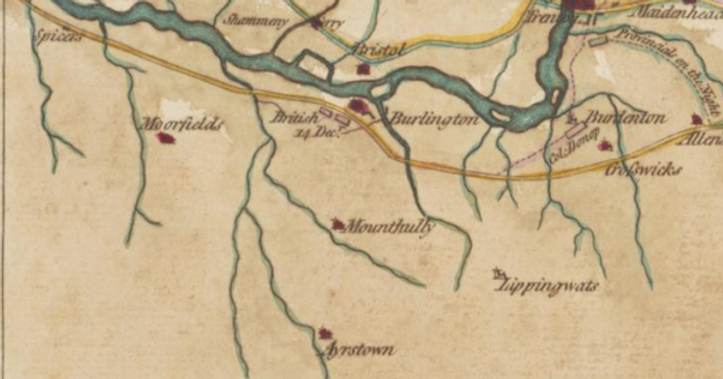
Map: “An Accurate Plan of the Country between New York and Philadelphia; With the Dispositions of the Forces: Extracted from the Gazette of Tuesday, Feb 25th, 1777.”
Created/Published by: Snow Hill [London]: S. Pyle, 1777.
https://www.loc.gov/resource/g3804n.ar304000/?r=0.029,0.397,0.544,0.208,0
Per the Library of Congress, the map above “shows positions of British (red) and American (blue) forces along the major highways between New York City and Philadelphia.”
Spicers would have referred to the area where Samuel Spicer owned property, which later became Merchantville and Pennsauken. Ayrstown likely refers to the unincorporated town of Eayrestown within Lumberton. Lippingwats is likely referring to Jobstown in Springfield Township, which was named after Job Lippincott, who owned a significant amount of land there.
The below is another map is considered a contemporary or near-contemporary of the retreat of the British Hessian troops from Philadelphia to Moorestown. The map was created in October 1777. The British/Hessians retreated from Philadelphia on … and arrived in Moorestown on June 20, 1778. The map includes Moorfield and Moorfield Creek.
When there wasn't enough room for British & Hessian soldiers to stay in the homes, they would set up locations in the fields. There were three such locations noted in Moorestown. The one on the right headed up Kings Highway (Main Street) is where they took over the Moorestown Quaker Meeting House and the field.
You need to imagine a town of 250-400 people. And Knyphausen with 8000 soldiers, ... women and children, 1500 carts. The wagon train stretched on for miles. All of them crammed in from the Bispham house through the Cowperthwaite home and various other smaller roads.
On the above map, you can see the route that General von Knyphausen and the British/Hessian troops under him took as they escaped Philadelphia and marched onto Haddonfield. They then Kings Highway into Moorestown very early on June 20th. This force encamped in and around Moorestown. They occupies many home, including the Smith-Cadbury Mansion, the Hessian House, ….., the Friends Meeting House, and Friend Meeting House.
https://www.westjerseyhistory.org/maps/revwarmaps/hessianmaps/index1.shtml
The below map is from the Revolutionary War Maps contained in Von Ewald'd Journal.
From the zoomed in version of his map, you can see he is referring to Moorefields at the top of the map and Moorestown at the bottom. This is the only time I saw a map which differentiated between them.
Here is the link to that map online.
-
1778 Monmouth Campaign:
-
British troops marched through Moorestown en route from Philadelphia to New York.
-
June 20: Gen. Knyphausen’s column (2,000 men) entered Moorestown.
-
Gen. Maxwell’s NJ Brigade nearby.
-
Joseph Bloomfield noted Moorestown was a station for American troops.
-
John Hunt’s Journal: Local Alarm
-
Oct. 23, 1777:
-
Describes fear of approaching Hessians.
-
Families took shelter in Moorestown.
-
Quakers sat in the Meeting House despite cannon fire.
-
A false alarm caused panic.
-
-
Nov. 1777:
-
Moorestown’s Meeting House housed American soldiers.
-
Local militia moved south to fight Hessians near Haddonfield.
-
Moorestown’s Lasting Burden
-
Moorestown never saw a major battle, but:
-
Troops passed through regularly.
-
Homes and barns were raided by both sides.
-
Quaker neutrality didn’t protect their property.
-
-
The war left the town changed.
William Franklin’s Fall
-
Benjamin Franklin’s son remained loyal to the Crown.
-
He was arrested in 1776.
-
Father and son never reconciled.
Legacy
-
The war ended in 1783.
-
Moorestown bore scars of fear, loss, and endurance.
-
Meeting House and other home still stands as a silent witness.
-
Roads, maps, and markers carry the town’s story forward.